Niklaus’s Madonna
Narcissus and GoldmundNiklaus’s Madonna is a wooden statue of the Virgin in a cloister church, made by Master Niklaus. Goldmund encounters it after confessing the death of Viktor, and its unusual combination of spiritual depth, worldly presence, beauty, and sorrow changes the direction of his life. The statue becomes not merely an object of devotion but the work that awakens his vocation, draws him to Niklaus, and gives him a standard for thinking about what art can preserve against mortality.
Appearance and setting
The statue stands in a side chapel, where a shaft of sunlight leads Goldmund’s attention toward it after mass. Its form is delicate rather than monumental: the Virgin leans forward gently, a blue cloak falling from narrow shoulders, and extends a fine, girlish hand. Her grieving mouth, rounded forehead, and living eyes combine sweetness and pain. Goldmund is particularly captivated by the mouth and the angle of the inclined neck, details that make the image seem present and inwardly alive rather than remote or merely conventional.
The priest tells Goldmund that the work has been in the church for only a year, donated by a benefactor of the religious order. Its reception is divided. Some viewers find it too modern and worldly to count as a proper image of the Mother of God, and accuse it of being untrue or exaggerated; others praise it. This disagreement locates the statue between established religious expectations and a more human, emotionally immediate way of representing the Virgin. Its spiritual force for Goldmund comes precisely through that union of bodily presence and inward meaning.
Goldmund’s encounter and artistic calling
Goldmund is deeply moved by the statue and repeatedly tries to leave, only to turn back toward it. He feels that it resembles something he has seen in dreams and intimations, an image for which he has long yearned but could not previously identify. When the priest asks whether he finds it beautiful, Goldmund answers that its beauty is inexpressible. Learning that Master Niklaus made it, he urgently asks who the sculptor is and where he can be found. The priest explains that Niklaus is a celebrated carver in the bishop’s city, about a day’s journey away, and encourages Goldmund to visit him.
The encounter supplies Goldmund with a goal. Until then, the road has been a place of freedom and passing experience; afterward, it is a route toward Niklaus and the possibility of becoming an artist. Goldmund reaches the city that same day, asks after the master, and searches for his house. The statue’s importance is therefore not only symbolic: it initiates a concrete change of direction, carrying Goldmund out of aimless wandering and toward sustained work.
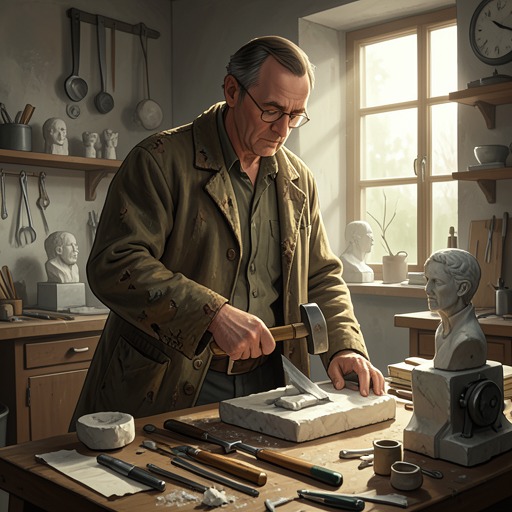
Niklaus does not admit Goldmund through the ordinary route into the craft. Guild custom expects apprentices to begin in early adolescence, serve for years, and have their apprenticeship paid for by their fathers. Goldmund is already a grown man, and Niklaus considers him too old for that status. Yet the master judges his drawing beautiful despite its faults and offers informal instruction without a contract or obligation to remain. The Madonna thus leads Goldmund not into a conventional apprenticeship but into a trial of artistic ability shaped by his unusual age and independence.
A standard for true art
Goldmund understands the Madonna as evidence that art can outlast the people who make and inspire it. He reflects that the model for the statue may already be dead, and that Niklaus too will die, while the work may remain in the quiet church for generations. Its persistence gives visible form to the hope that artistic creation can salvage something from the instability of life. The statue’s enduring presence stands in contrast to the flowers and leaves that perish, and to the human lives that disappear.
As Goldmund learns to carve, the Madonna becomes his principal example of what he calls true art: an image created through a mysterious, receptive process rather than through vanity or the display of technique alone. He believes that the artist must allow an essential image to emerge, instead of imposing a merely deliberate design. His own work on a wooden Saint John, modeled on Narcissus, helps him understand this conviction. At moments of concentrated work, he feels that the image comes through his hands rather than being manufactured by his will. He connects this experience to the Madonna, which he has visited repeatedly on Sundays, and regards it as a sacred image of the soul rather than an ornamental object.
The distinction also sharpens his dissatisfaction with pieces made chiefly to please patrons or display craftsmanship. Goldmund sees that even elegant, technically accomplished objects can remain spiritually slight when they arise from ambition, commercial demand, or delight in skill for its own sake. The Madonna shows him that trained hands and eyes matter, but technique must serve a deeper vision. Its unity of emotional intensity and mastery becomes the difficult standard by which he measures both himself and the settled workshop life offered by Niklaus.
Repeated visits and lasting influence
Years after first seeing the Madonna, Goldmund returns to the cloister on horseback after an occasion of recognition in Niklaus’s household has left him unexpectedly dissatisfied. The statue again delights and overcomes him. Now, as a practicing carver, he notices details unavailable to his earlier, untrained gaze: the soft movements of the gown, the daring treatment of the long hands and fingers, and Niklaus’s sensitive use of the wood grain. He recognizes that the work’s apparent freedom rests on deeply practiced eyes and hands, as well as on the simplicity and depth of its vision.
This second viewing complicates Goldmund’s attraction to a life of freedom and experience. The Madonna makes him consider whether an artist might justifiably devote an entire life to craft, accepting limits on wandering in order to create a work that is both fully imagined and executed with mastery. He leaves the church full of questions and doubts rather than with an easy resolution. The statue does not settle the conflict between artistic discipline and the wandering life; it makes the cost and possibility of both clearer.
The image remains part of Goldmund’s artistic memory when he later plans work for the refectory at Mariabronn. He wants his carvings to belong to the architecture and communal life of the cloister rather than stand as arbitrary decoration. In designing the lectern, he divides it between representations of the natural world and the word of God, and assigns the features of Saint Luke to Master Niklaus. This plan shows how the Madonna’s maker has become part of Goldmund’s own visual and personal inheritance. The statue’s lasting significance lies in the way it joins devotion, human feeling, technical achievement, and the persistence of art: it gives Goldmund a goal, but also leaves him measuring the distance between a beautiful object and an image that can speak to the soul.